If interested in AI, check my other page where I write on prospects for LLM tutors.
Please also subscribe to make sure you will not miss future posts. Subscription is free. Your email will not be used for other purposes. You will receive no advertisements.
-+-+-+-+
The title is a Turkish legal term that almost nobody outside legal circles had heard until recently. It means “Absolute Nullity”.
A Turkish court last week effectively reset the main opposition CHP to November 2023. Everything that happened after the 2023 Party Congress was declared legally void: leadership changes, internal decisions, and party appointments. In practical terms, the court ordered the restoration of the pre-2023 leadership.
This is an unprecedented act and indicates a renewed ambition by the Turkish elite to prolong the Erdoğan era.
Last year I thought the Erdoğan era was entering its final phase. Clearly, I underestimated the resilience of the system around him.
What changed is not simply Turkish domestic politics. The entire post-Cold War order is under strain. Washington’s authority is weaker than it was even two years ago. West Asia is entering another phase of strategic instability following Trump’s confrontation with Iran. In such an environment, the consensus by the Turkish elites appears to be favouring the safety of continuity against experimentation.
Will it work?
This is a “Hail Mary” pass by the Erdoğan regime. It gives the regime a chance it otherwise may not have had. It is also risky because it openly politicises the judiciary in a way that could fracture the legitimacy of the electoral system itself.
KK was brought to the head of CHP in 2010, at the peak of the Gülenist onslaught against the Republic. He lost many elections against Erdoğan and finally lost the CHP leadership at the 2023 Congress. CHP only began consistently defeating Erdoğan after KK was no longer the leader. This may be a coincidence. Last week, however, the court removed the current CHP leadership and restored KK and his team.
Barring a judicial reversal, what happens now will largely depend on what KK plans to do with the new authority bestowed on him by Erdoğan’s courts.
I do not know KK personally and the following is pure speculation. I mean no disrespect to anyone. The two extreme scenarios are:
Scenario 1: KK believes he was wronged
KK is 77 years old. He may genuinely believe that the Erdoğan era is coming to an end and that his removal from the CHP leadership was a plot designed to deprive him of the final triumph after a thirteen-year struggle against Erdoğan.
If that is how he thinks, then he may also believe that the true believers of the party would support him in a fair internal election. In that case, he would likely move towards a new Party Congress within months.
A Congress could therefore take place before the end of 2026. I do not think KK would win a leadership position in such a Congress, but I may be wrong. One way or another, the speculation surrounding CHP would end at that point and the political focus would shift back to the next elections and the presidential candidates.
Scenario 2: KK is acting as part of a broader political design
KK is not acting as an independent political agent. In that case, he may use his renewed tenure to maximise Erdoğan’s electoral chances.
This could mean stretching the turmoil inside the party until Erdoğan declares elections, complicating opposition coordination around presidential candidates, and generally paralysing the opposition.
The darker possibility involves the election process itself.
Turkey’s electoral system is actually fair and transparent by regional standards, but its integrity depends heavily on participation by opposition scrutineers during the vote count.
Voters mark paper ballots and place them into sealed ballot boxes. At the end of voting, representatives of the major parties jointly open the boxes and count the votes. The results are recorded on official forms signed by all participating scrutineers. The ballots are then resealed and transferred to the electoral authorities.
The official district-by-district counts are published online, allowing parties to compare the published numbers against the records kept by their own scrutineers. If discrepancies emerge, objections may be lodged and recounts demanded.
In such a system, large-scale fraud becomes extremely difficult — provided the opposition parties are organisationally capable of sending scrutineers to every ballot box. If they fail to do so, the predictability of the process weakens considerably.
The ambiguity of the Erdoğan record
Despite what many opposition figures claim, it is difficult to describe the twenty-five years of Erdoğan rule as a complete failure. The following chart shows the change in Turkish GDP over the last quarter century:
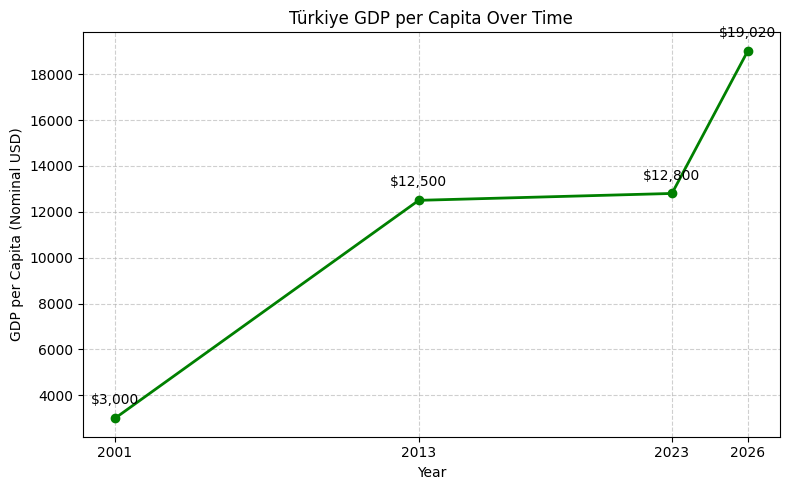
Of course, macroeconomic numbers are only part of the story. The dramatic increase in per capita GDP was not enjoyed equally across the population. Especially during the last three years, ordinary Turks experienced severe impoverishment.
Yet despite high inflation and declining living standards, Erdoğan has retained a remarkably resilient electoral base in the 30–40% range.
There are also indications that economic conditions may be stabilising. The Central Bank’s total reserves in gold and hard currency are now roughly US$160 billion gross. Excluding swap-related currency holdings, net reserves are approximately US$35 billion.
If the economy stabilises even modestly while the opposition descends into prolonged internal warfare, Erdoğan may once again achieve what many thought impossible only a year ago: political survival through fragmentation of his opponents rather than renewed popular enthusiasm.
-+-+-+-+
-+-+-+-+
Comparing Istanbul and Brisbane prices - AT index
Based on my basket of goods, I compare Turkish and Australian prices. Both Coles (AU) and Migros (TR) prices are expressed in Turkish liras in the following tables. I converted Coles prices to Turkish liras at the exchange rate of 1AUD=32.68TRY.

I started this section on 5 July 2024. The Turkish prices initially rose fast. Since February 2025, the Turkish prices had been getting increasingly lower compared to the Australian prices. The trend seems to have been reversing with the Turkish prices rising again compared to the Australian prices but is highly volatile.
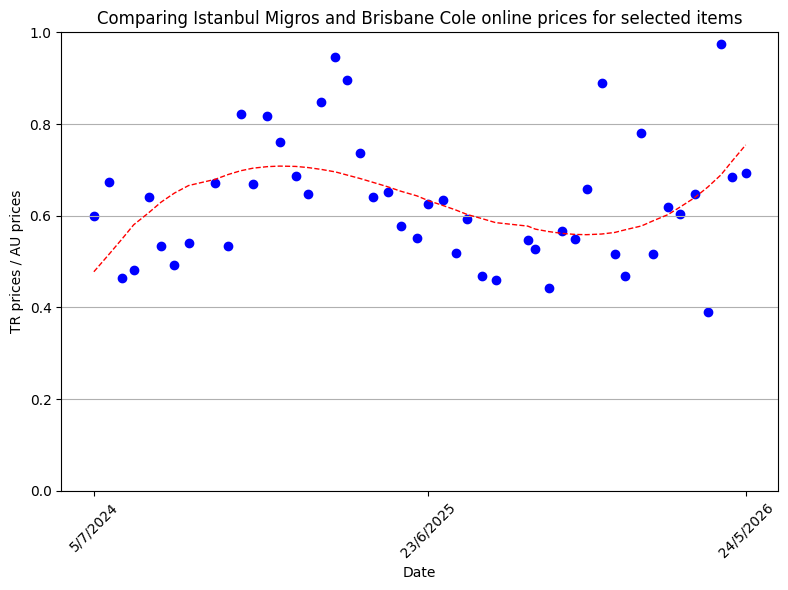
Some items, e.g. beef mince and rice, have consistently been more expensive in Istanbul. Raw data can be downloaded from my github page.
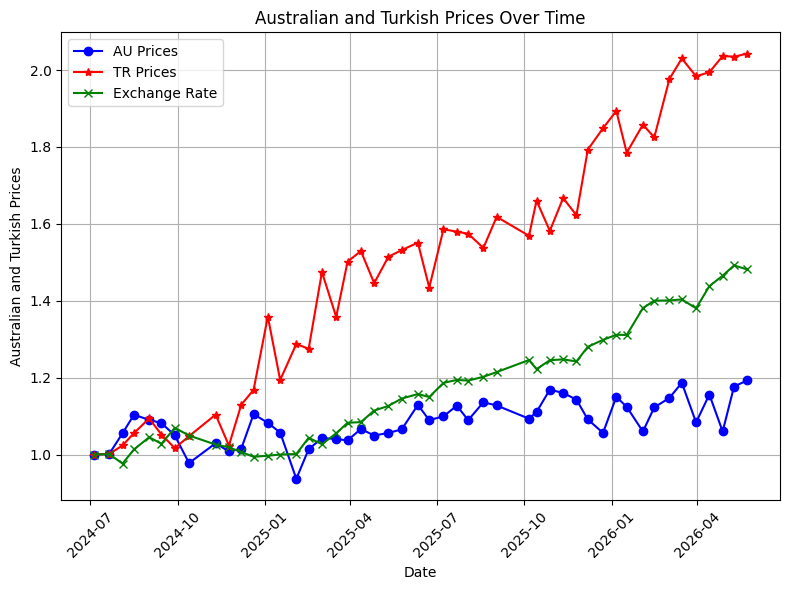
The following chart shows the variation of the total cost for the basket in each country separately taking 5 July 2024 as the base.
Wages
The Australian minimum wage was increased to almost $25/h on 3 June 2025. This corresponds to A$4000/month for a 160-hour month. The Australian workers being paid the minimum wage are about 2.6 million or about 18% of the total Australian work force.
The minimum wage in Turkey is 26,000 TRY/month.
The code to create the above tables and the charts is in my github repository and can be downloaded if you are interested
Statistics
The current count is 492 subscribers; 672 followers.
I thank you all for your support. Please continue your shares and mentions.