Gods of Distant Suns
Is our conception of God large enough for the universe we have discovered?
If interested in AI, check my other page where I write on prospects for LLM tutors.
Please also subscribe to make sure you will not miss future posts. Subscription is free. Your email will not be used for other purposes. You will receive no advertisements.
-+-+-+-+
Is our God also the God of the universe?
The first book of the Old Testament, The Book of Genesis begins with:
“In the beginning God created the heavens and the earth.”
The Qur’an likewise describes God as the creator of all existence and:
“All praise is due to Allah, Lord of the worlds.” (Qur’an, 1:2).
The Eastern religions generally do not have a single creator God, but their conception of the divine is also cosmic rather than local. In the Bhagavad Gita, Krishna describes himself in universal terms:
“I am the source of all spiritual and material worlds. Everything emanates from Me.” (Bhagavad Gita 10.8)
These statements are from a time when humanity’s view of the universe was limited to the Earth, the Sun, the Moon, and a scattering of stars. Yet all of them make claims that extend beyond the local world and encompass the cosmos as a whole.
Today we know that the universe is unimaginably large. This by itself is not a problem for religion. If humanity is the only intelligent species in existence, then there is nobody else with whom we must share our God.
The situation changes if intelligent life is common.
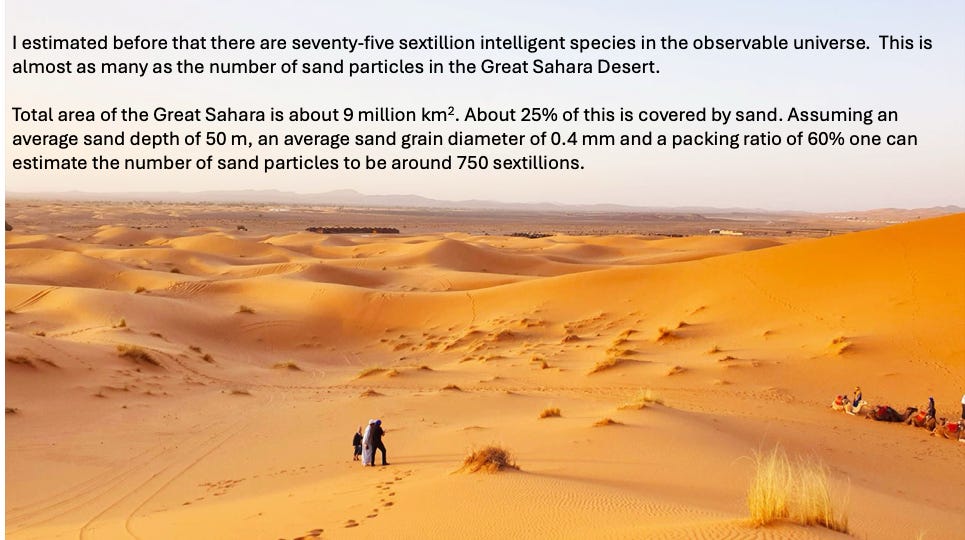
In January 2026, I estimated the number of planets that support intelligent species in the observable universe. The result was approximately 7.5 × 10²² or seventy-five sextillions. This is a number so large that it is comparable to my estimated number of grains of sand in the Great Sahara Desert1.
There are many ways in which one can reflect on such a number. In this article, I will reflect on the religious implications.
No Species Bias
For the purposes of this discussion, I will assume that every intelligent species has been visited by God, or by a god. The alternative would be to assign a unique and privileged status to humanity among the seventy-five sextillion intelligent civilizations that may exist in the observable universe.
This is not impossible. Many religious traditions already regard humanity as special. Yet I find it difficult to believe that, in a universe containing countless intelligent species, divine revelation occurred only once, on one planet orbiting one ordinary star.
If divine revelation is widespread, a deeper question emerges. Are all these civilizations encountering the same God, known by different names and understood through different cultures? Or do each have their own god?
The question then becomes whether there is one universal God or whether all gods are local.
The Universal God
Can one single agency watch over seventy-five sextillion intelligent species distributed across the observable universe, which has a diameter of 93 billion light years?
Clockmaker God
Maybe the Creator designed the universe and then set it in motion like a clockmaker winding a clock. He is not an intrusive God and lets things run its course. This was a concept favoured during Scientific Revolution by such luminaries like Voltaire, Thomas Paine and others.
The scientific consensus on the origins if the universe is that
The universe started from an extremely hot, dense state.
As it expanded, the universe cooled, allowing elementary particles, then atoms, and stars, and finally galaxies to form.
Seventy-five sextillion intelligent species evolved in the habitable planets orbiting the starts in these galaxies.
The concept of a clockmaker God is perfectly appropriate for this narrative on the origins of the universe. The God designed the laws of nature and released the universe from a densely wound initial state. Since then, He may be observing but He does not interfere.
What would be his motivation? Maybe it is an experiment. The information is not destroyed and when the universe reaches its end the Creator compiles and reviews all data.
God of Augustine
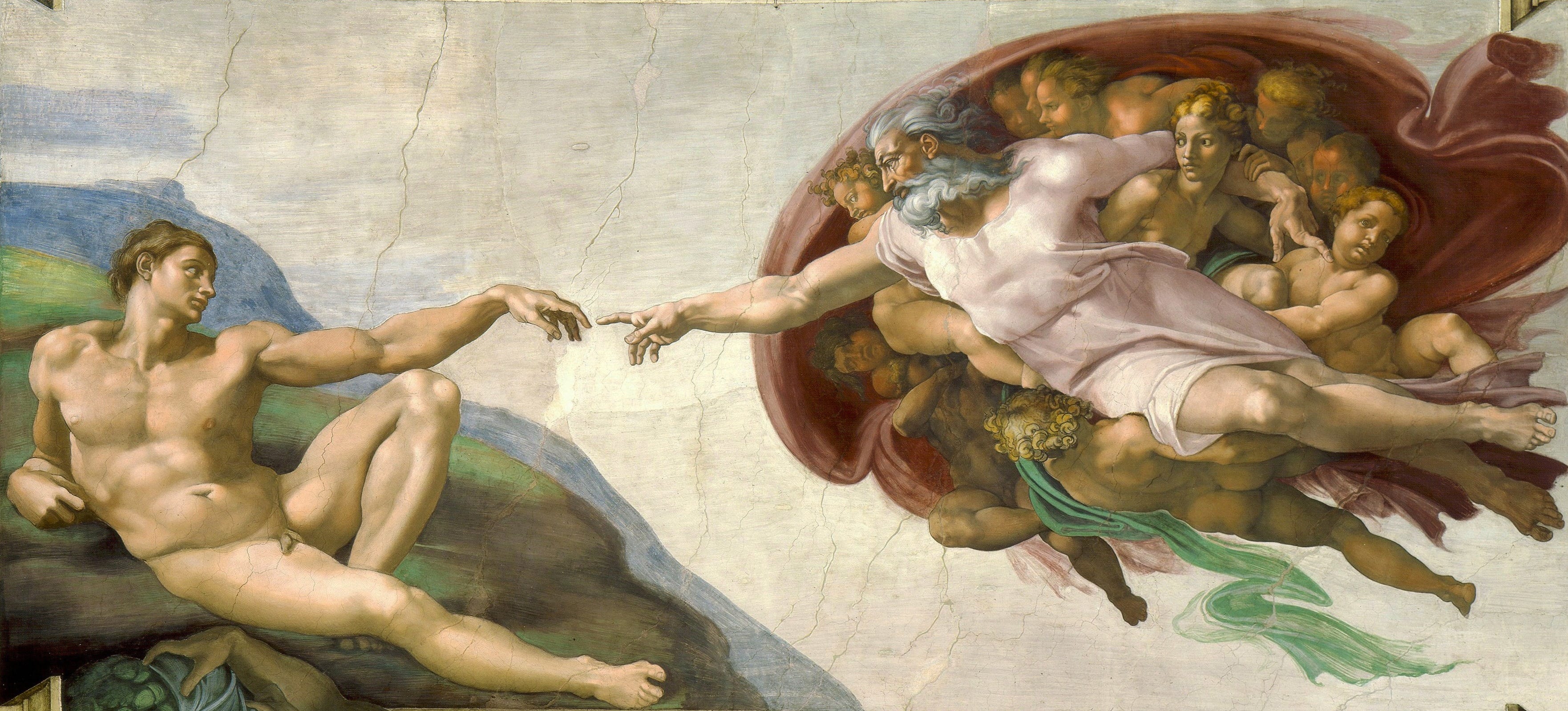
For Augustine of Hippo, creation is not like winding up a clock and walking away. He believed that a universe left entirely to itself would return to nothingness, because it had been created out of nothingness. It continues to exist only because God continuously holds it in existence. If God ceased willing the universe to exist, it would simply cease to be.
This is a challenging notion even for a single intelligent species living on a single world. A providential God guiding the lives of billions of individuals living in each of the seventy-five sextillion intelligent civilisations is difficult to imagine.
When the creation is unique, it is its own meaning. When the creation is repeated 75 sextillion times, one needs a different explanation.
My principal objection is not divine capability. In any discussion of this type, I must assume that God is infinitely capable. The question is motivation, or perhaps purpose. Why create seventy-five sextillion intelligent species? What is the meaning of such abundance?
The Divine Network
There is, however, another possibility. According to the Book of Genesis, God said:
“‘Let us make mankind in our image, in our likeness…”.
Perhaps the image of God is not fully reflected in any single intelligent species. Perhaps each civilisation reflects only part of the divine nature
An infinitely complex entity would possess an infinite number of atributes. Maybe each of the 75 sextillion civilisations reflect a different subset of these attributes. In that case, each civilisation (including humanity) would be only one pixel in a cosmic portrait and only the universe as a whole would offer a comprehensive reflection of God.
In this formulation, God resembles an intelligence distributed across the universe. If God is infinite, no single species could mirror the whole image. We are all nodes in a vast cosmic network, each processing a different aspect of the divine mind.
The Religious Fermi Paradox
If there is one God for the entire universe and He is an interfering God as envisaged by Augustine of Hippo, wouldn’t He find it useful to offer lessons derived from the unique experiences of the other interstellar civilisations? These lessons would probably not arrive as news reports, but perhaps as parables, visions, or revelations. Why would God build impermeable walls between His different disciples from. different stars?
Enrico Fermi asked, if life is common, why is the universe silent? The question is more important for theology: If God is actively managing his cosmic flock, why is there no spiritual cross-talk?
The Address of God
Where does God live? When talking of a God for humanity only, with open skies above us stretching out indefinitely, the answer probably would be”somewhere out there”. This answer does not work in a near-infinite universe with 75 sextillion intelligent civilisations believing in the same God. This is probably more a problem for a Clockmaker God who sets the clock, starts it and then leaves. For a distributed cosmic intelligence mentioned in the previous secrtion, there is no need to look for a separate place. God is inseparable from the universe.
Local Gods - Return of the Cosmic Pantheons?
Another possibility is the existence of different Gods for different intelligent civilisations. The omnipotence of such Gods would be limited to their local solar systems. Maybe the speed of light limitation applies here and there is no meaningful communication between gods of different solar systems. If this is true, then each God would be single all-powerful divine entiry in its System. The narratives developed by the Earth’s thinkers in the past on Gods and Divine Questions would probably apply to all species.
Conclusion
I wrote this only to demonstrate that a semi-infinite universe with possibly 75 sextillion intelligent planets cannot be addressed by the theological concepts developed for a single species, humanity, living on one world, the Earth.
For most of human history, theology concerned itself with one intelligent species living on one world. If the universe contains seventy-five sextillion intelligent civilizations, that assumption may no longer be sufficient.
The question is no longer whether God exists.
The question is whether our conception of God is large enough for the universe we have discovered.
-+-+-+-+
-+-+-+-+
Comparing Istanbul and Brisbane prices - AT index
Based on my basket of goods, I compare Turkish and Australian prices. Both Coles (AU) and Migros (TR) prices are expressed in Turkish liras in the following tables. I converted Coles prices to Turkish liras at the exchange rate of 1AUD=32.57TRY.

I started this section on 5 July 2024. The Turkish prices initially rose fast. Since February 2025, the Turkish prices had been getting increasingly lower compared to the Australian prices. The trend seems to have been reversing with the Turkish prices rising again compared to the Australian prices but is highly volatile.
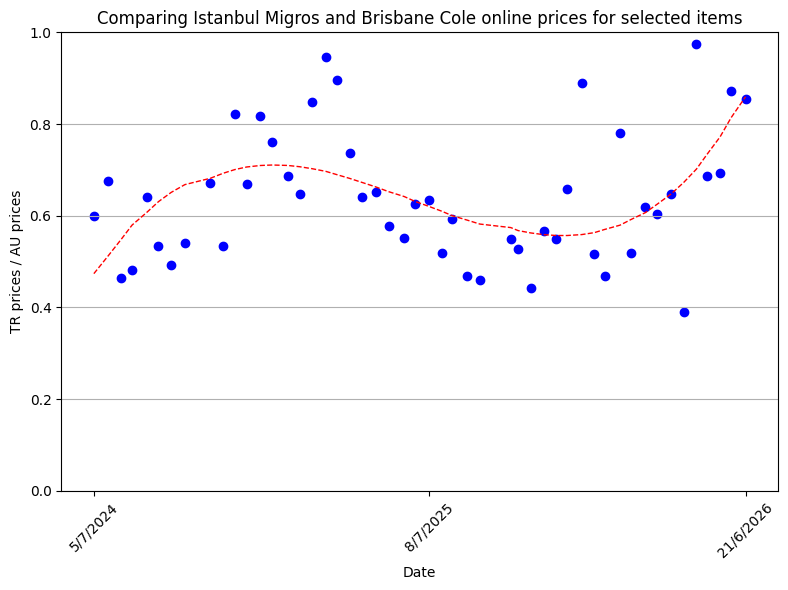
Some items, e.g. beef mince and rice, have consistently been more expensive in Istanbul. Raw data can be downloaded from my github page.
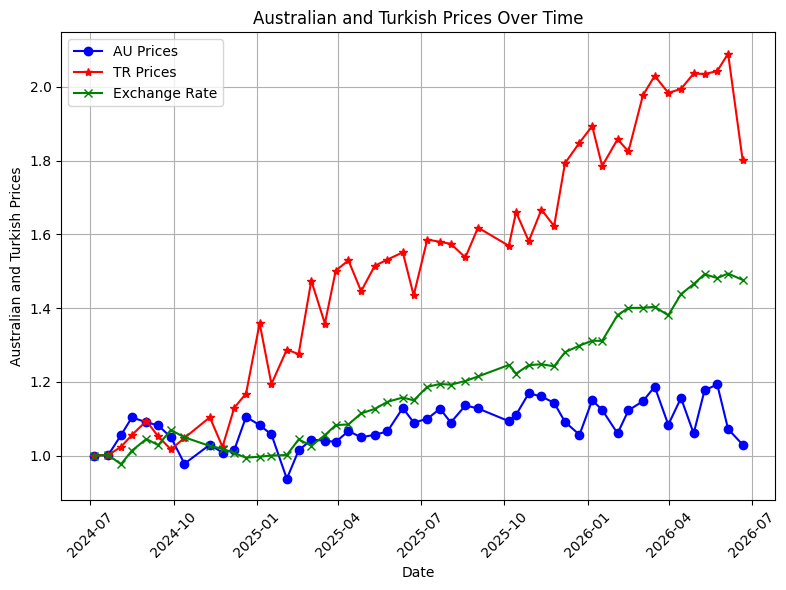
The following chart shows the variation of the total cost for the basket in each country separately taking 5 July 2024 as the base.
Wages
The Australian national minimum wage increased to A$26.44 per hour on 1 July 2026. This corresponds to approximately A$4,230 per month based on a 160-hour working month. However, the national minimum wage applies to only a small proportion of Australian workers. More important are the modern award wages, which cover around 21% of all employees. The lowest award classifications are closely aligned with the national minimum wage and, in many cases, are slightly higher. As a result, changes to award wages generally have a much greater impact on Australian workers than changes to the national minimum wage itself.
The 2026 minimum wage in Turkey is 33,000 TRY per month (before tax). In contrast to Australia, where only a small minority of workers receive the statutory minimum wage, the Turkish minimum wage serves as a benchmark for a large share of the labour market. It is therefore both an economic indicator and a major political issue.
The code to create the above tables and the charts is in my github repository and can be downloaded if you are interested
Statistics
The current count is 499 subscribers; 685 followers.
I thank you all for your support. Please continue your shares and mentions.
Total area of the Great Sahara is about 9 million km2. About 25% of this is covered by sand. Assuming an average sand depth of 50 m, an average sand grain diameter of 0.4 mm and a packing ratio of 60% one can estimate the number of sand particles to be around 750 sextillions.
I have always assumed that all cultures on Earth are referring to the same God, even if they don't think it.
Reading this, my mind draws the same conclusion. If there is a God/creator that could create our world, it doesn't make sense that He has a finite amount of creative power. It seems that this is a different plane where our idea of limits do not apply. Surely one who could create all this has no limits.
This was an interesting summary on the speculations about something mankind has wondered forever... I said speculations because none can be classified even as hypothesis let alone any verification! Of course we have limits to our understanding of the universe that we cannot see as a whole and our science knowledge may yet be limited to grasp even the visible portion of it of immense size. Multiverse theories (a bit more than speculations at the moment) conclude that there might be other universes beyond every black hole but information conserved in one universe cannot cross the that boundary to the other side. If there is(are) experimenting being(s) on the other side of the event horizon they won't be able to review the results later on. Even if they could have the possibility to sort through so many alternate worlds they would be overly disappointed with their creation here on earth, overwhelmed by one stupid species ruining their only available livable planet. In any case gods -philosophical creations of humankind- of any kind did not help to make them even a bit more intelligent whether they exist or not!