Beyond the Predator
My take on Jeffrey Epstein. I see it as a perversion of social pathways. These pathways were invented in the last fifty years to help modern liberal democracies continue to operate.
If interested in AI, check my other page where I write on prospects for LLM tutors.
Please also subscribe to make sure you will not miss future posts. Subscription is free. Your email will not be used for other purposes. You will receive no advertisements.
-+-+-+-+
For those of you who did not read my past posts on elite consensus, I give a summary below. In this first paragraph, suffice it to say that elite consensus is very important. This important phenomenon is a dynamic state that needs continual maintenance. Various channels exist to facilitate this maintenance function. I see Epstein not just as a predator but as a case-study in how these channels can be hijacked and perverted. He was very effective. Without his deep character flaws and depravity, Epstein might have become a highly influential facilitator. To understand his rise and fall is to understand a specific vulnerability within liberal democracies.
The rise of Jeffrey Epstein
Despite lacking a college degree, Jeffrey Epstein was hired in 1974 as a physics and mathematics teacher at the prestigious Dalton School in New York City. Dalton is an elite incubator whose students come from the most affluent and well-connected families in America.
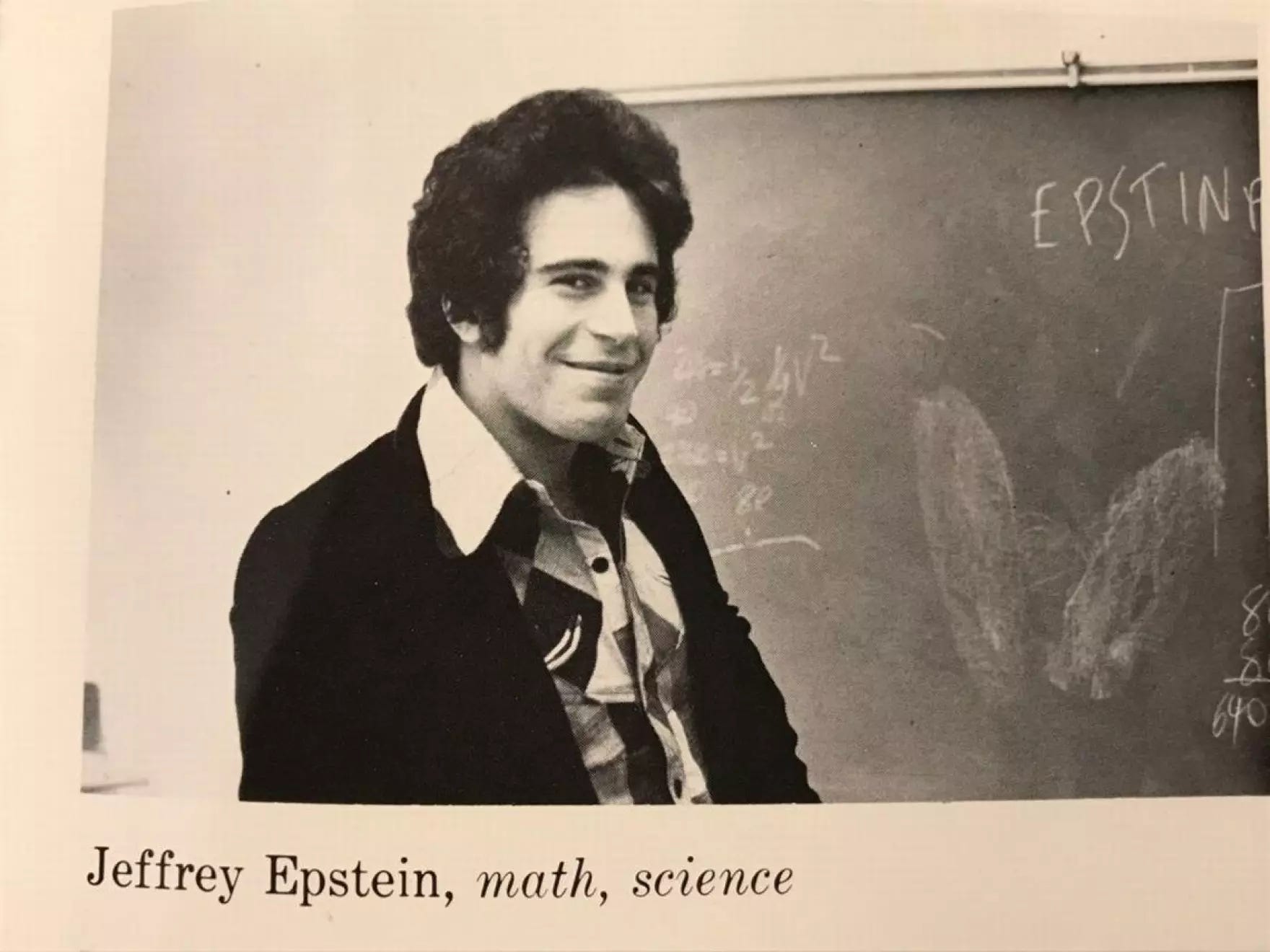
Although he was dismissed for “poor performance” after two years, that brief tenure was enough to embed him in a network of wealthy parents. Their introductions facilitated his jump into Wall Street, first at Bear Stearns and later as a financial manager for clients like Leslie Wexner, founder of L Brands (Victoria’s Secret).
By his late 30s, Epstein had amassed a fortune that made him a multimillionaire. By the time of his death in 2019, he was worth nearly $600 million. His wealth did not come from traditional investment banking, but through opaque management services and complex tax arrangements for the ultra-wealthy.
The Fall of Jeffrey Epstein
While others might have retired to a life of quiet luxury, Epstein sought to become a central node in the global social fabric. Using his wealth, he began hosting parties and cultivating influential guests. Over time, these gatherings became inextricably linked to the sexual exploitation of underage girls.
Despite a 1996 complaint to the NYPD and FBI that yielded no substantive action, Epstein’s circle of influential friends continued to grow. Even after a 2005 investigation led to a controversial 2008 “sweetheart deal”—resulting in a 13-month sentence with work-release privileges—Epstein’s social standing remained remarkably resilient.
Documents released by the U.S. Justice Department and congressional committees reveal extensive correspondence with business leaders, academics, and politicians long after his conviction. While these files do not prove criminal complicity, they underscore how effectively Epstein positioned himself within elite networks. It took the persistence of survivors like Virginia Giuffre and relentless investigative journalism to shift the political climate toward the federal sex-trafficking charges filed in July 2019. One month later, Epstein was found dead in his jail cell.
A Rorschach Test for Global Media
The vacuum created by Epstein’s death and the initial reluctance of authorities to release full files allowed various narratives to proliferate:
In Australia: The media largely framed it as a criminal enterprise—a common predator peddling sex—with a specific focus on the involvement of British royalty.
In Turkey: Commentators, often skeptical of official U.S. narratives, framed the case through the lens of “kompromat” and foreign intelligence. Influential figures like Admiral Cihat Yaycı suggested Epstein was co-opted by allied intelligence services for international influence operations.
On the Political Left: Social media users viewed the event as a symptom of systemic institutional rot within Western capitalism.
On the Political Right: Particularly in the U.S., the case was often conflated with “Pizzagate” theories, casting Epstein as a henchman for a secret cabal.
I see the Epstein phenomenon differently: not as a singular crime, but as a disease. Akin to dysfunctional mitochondria turning healthy cells cancerous, Epstein perverted a social mechanism that is otherwise essential to the functioning of liberal democracies.
Understanding Elite Consensus
In December 2023, I wrote about the importance of elite consensus, a concept championed by scholars like Stefan Dercon. In a healthy democracy, this is the tacit agreement among influential actors on the fundamental frameworks that keep the political economy stable. When this consensus frays, policy coherence and public trust dissolve.
This is not a “secret cabal” theory. It is a recognition that, at any given time, a dynamic cohort of politicians, business leaders, and intellectuals shapes a nation’s direction. For a society to remain healthy, this cohort must be permeable. It needs constant renewal of the membership through meritocratic pathways.
The Stagnation of Mobility
When meritocratic pathways narrow, societies stagnate. The United Kingdom has long struggled with entrenched class divisions. The United States is now seeing its own elite enclaves consolidate. Wealth, geographic segregation, and exclusive social access have reduced the “permeability” that once allowed for broader participation in elite discourse.
To counter this isolation, new “artificial” pathways for social connection were created. In the 1990s, terms like “networking” and “socializing” moved from casual verbs to essential business strategies. These activities were designed to facilitate the diffusion of new ideas and new people through the layers of society.
Epstein exploited these exact pathways. He inserted himself into elite networks not through merit, but through social engineering and the commodification of access. His motive was proximity to power—a modern, dark variation of Jay Gatsby’s ambition, stripped of Gatsby’s “extraordinary gift for hope.”

Conclusion
The Epstein phenomenon is a specific pathology of affluent liberal democracies. While sexual depravity exists everywhere, it takes different forms under different regimes.
In an absolute monarchy, power is concentrated in the sovereign’s immediate circle; one would need entirely different means to gain the King’s ear. In a one-party system like the People’s Republic of China, the CCP maintains a monopoly on elite formation. The U.S. style of “autonomous networking” simply wouldn’t yield the same returns there.
Epstein was not an inevitable byproduct of democracy, but he was a parasite that could only thrive by mimicking the very mechanism—social permeability—that keeps a free society moving.
-+-+-+-+
Books I Read
George Saunders, Vigil. A disappointment ⭐️⭐️
Ian McEwan, What We Can Know, He is always a pleasure to read but this is probably below his average ⭐️⭐️⭐️
Robert Goddard, Out of the Sun, Goddard is always good, ⭐️⭐️⭐️⭐️
Julian Barnes, A Sense of Ending, It is always difficult for me to empathise with the angst of London’s poshy public school kids. Otherwise, Barnes is always great value. ⭐️⭐️⭐️⭐️
-+-+-+-+
Comparing Istanbul and Brisbane prices - AT index
Based on my basket of goods, I compare Turkish and Australian prices. Both Coles (AU) and Migros (TR) prices are expressed in Turkish liras in the following tables. I converted Coles prices to Turkish liras at the exchange rate of 1AUD=30.46TRY.

I started this section on 5 July 2024. The Turkish prices initially rose fast. Since February 2025, the Turkish prices had been getting increasingly lower compared to the Australian prices. The trend seems to have been reversing with the Turkish prices rising again compared to the Australian prices but is highly volatile.
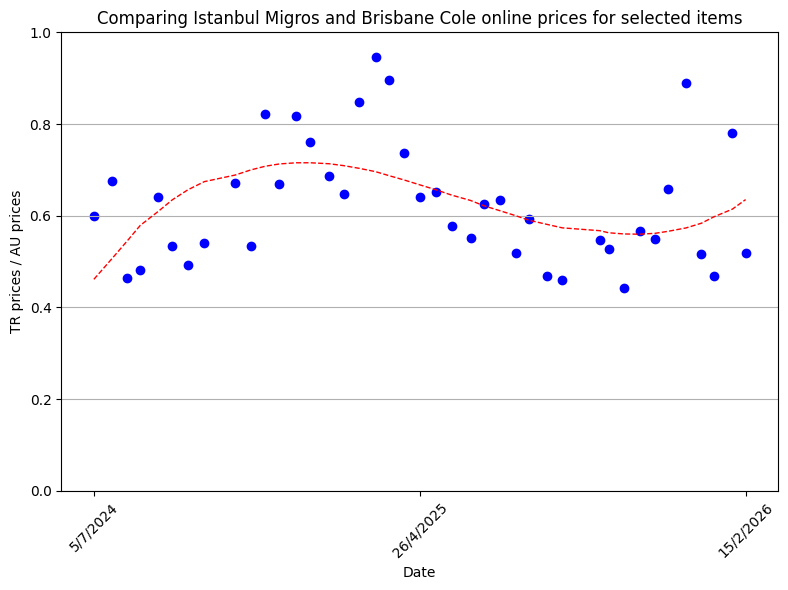
Some items, e.g. beef mince and rice, have consistently been more expensive in Istanbul. Raw data can be downloaded from my github page.
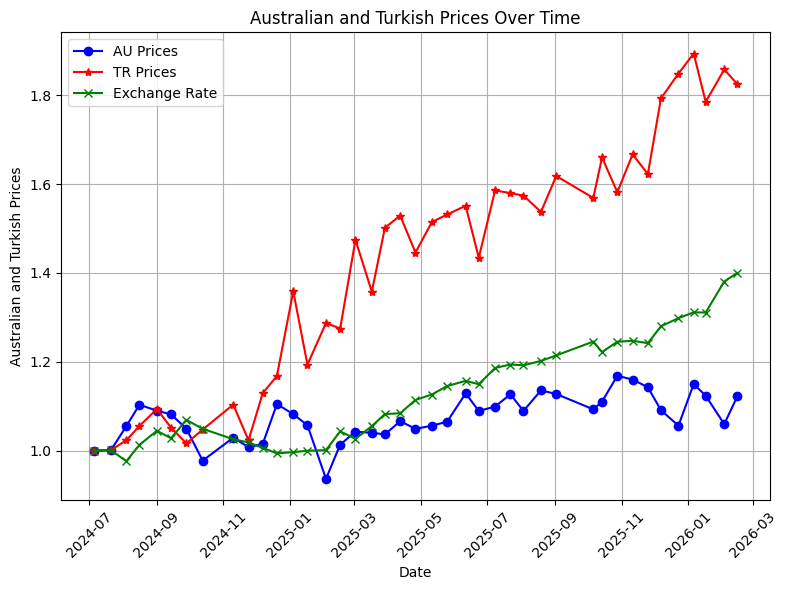
The following chart shows the variation of the total cost for the basket in each country separately taking 5 July 2024 as the base.
Wages
The Australian minimum wage was increased to almost $25/h on 3 June 2025. This corresponds to A$4000/month for a 160-hour month. The Australian workers being paid the minimum wage are about 2.6 million or about 18% of the total Australian work force.
The minimum wage in Turkey is 26,000 TRY/month. At the current exchange rate this corresponds to A$1018/month.
The code to create the above tables and the charts is in my github repository and can be downloaded if you are interested
Statistics
The current count is 446 subscribers; 578 followers.
I thank you all for your support. Please continue your shares and mentions.