Arrakis
A brief note on the connection between the Frank Herbert classic Dune and the Iran war
If interested in AI, check my other page where I write on prospects for LLM tutors.
Please also subscribe to make sure you will not miss future posts. Subscription is free. Your email will not be used for other purposes. You will receive no advertisements.
-+-+-+-+
Following Trump’s infelicitous Iran war, Dune may well find its way onto the recommended reading lists of military academies such as United States Military Academy and Royal Military College, Duntroon.
Frank Herbert extrapolated from trends already visible in the early 1960s and correctly sensed the growing strategic centrality of the Middle East. The analogy in Dune was never subtle. Spice was oil. Arrakis was the desert Middle East. The Fremen were the hardened peoples of the desert.
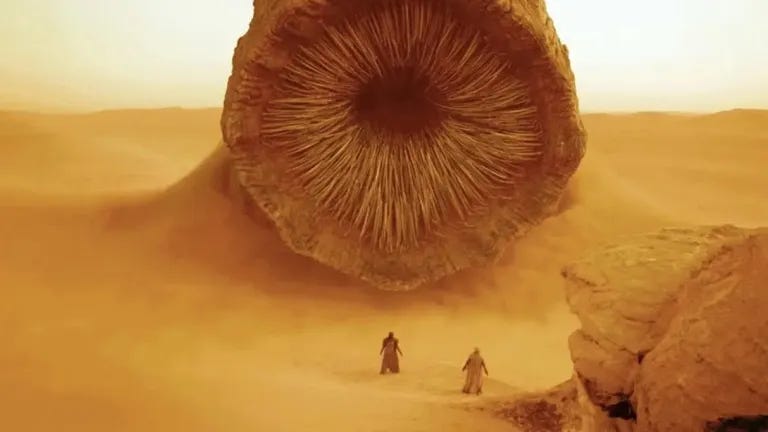
Herbert understood something deeper than simple resource politics. Dependency creates weakness. In the Dune universe, the Empire appears omnipotent, yet it is trapped by its absolute dependence on spice for interstellar navigation.
The second, and perhaps more important, insight in the novel was the deterrent power of resource denial. Paul Atreides gains leverage not because he can conventionally defeat the Empire, but because he can threaten the destruction of the spice cycle itself.
“He who can destroy a thing has the real control of it,” Paul said. “We can destroy the spice.” (Frank Herbert, Dune, pp. 535-536. Kindle Edition)
That is very close to Iran’s strategic logic in threatening closure of the Strait of Hormuz, through which roughly twenty percent of global seaborne oil trade passes, along with other essential exports tied to Gulf shipping routes.
I think the war is closing. The United States and Israel do not appear to have many military options left that do not involve escalation into far more dangerous territory. A ground invasion of Iran was never realistic. Someone within Trump’s advisory circle has probably read Dune and understands how the Imperial assault on Arrakis ultimately ended.
Wollongong
Until the late 1990s, BHP produced most of the steel Australia required. The great steel cities were Newcastle, Whyalla, and Port Kembla, the industrial heart of Wollongong.
Then BHP decided to exit steelmaking. Newcastle Steelworks closed in 1999. Whyalla survives on something resembling life support. Port Kembla endured, despite relentless pressure from overseas competition.
I first visited Port Kembla thirty-five years ago in another professional life while inspecting a ship-loader failure for an insurance company. Since then I have returned many times for different reasons. For the last three years, I have travelled there twice annually to chair the advisory board of a university research centre.
I was there again earlier this week for the first meeting of 2026.
Itinerary
Uber to Brisbane Airport: Tesla Model Y, 30 km in 26 minutes, $63 — of which $13 were tolls for the Clem7 tunnel and the Airport Link)
Brisbane to Sydney on a Qantas Boeing 737. Flight time: 75 minutes, landing around 3:30 pm..

Picked up the Avis rental car, a Subaru SUV. Pleasant to drive, although excessively attentive. The car clicked and beeped whenever I drifted slightly toward an adjoining lane, glanced too long at a road sign, or apparently failed some invisible attentiveness test set by the machine.
Arrived in Wollongong at around 5:30pm and checked in to Novotel Northbeach.
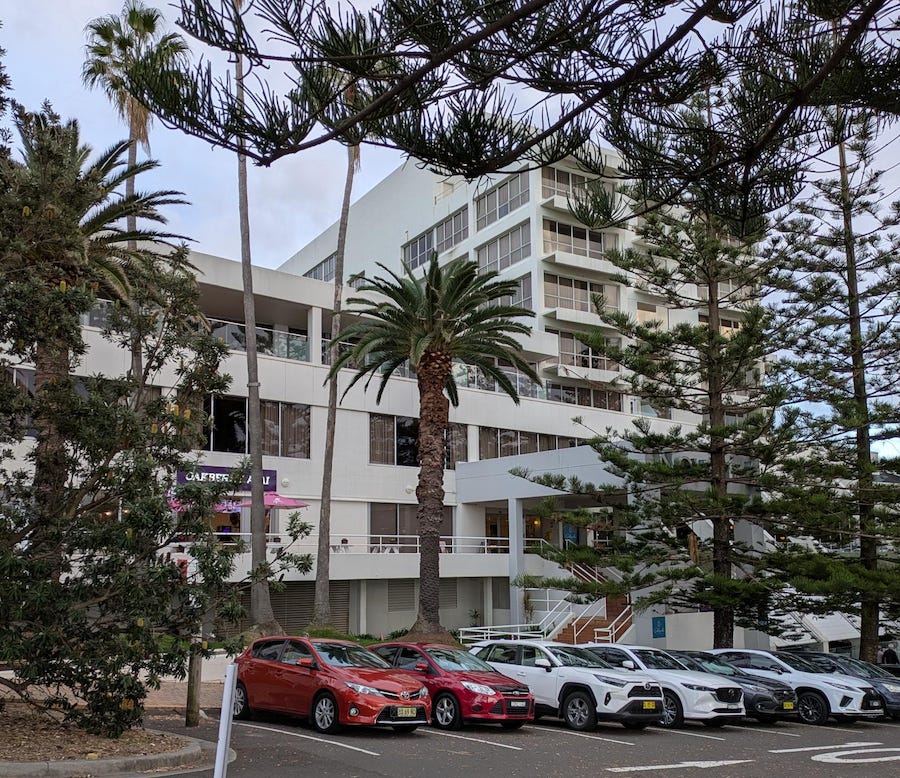
In Wollongong
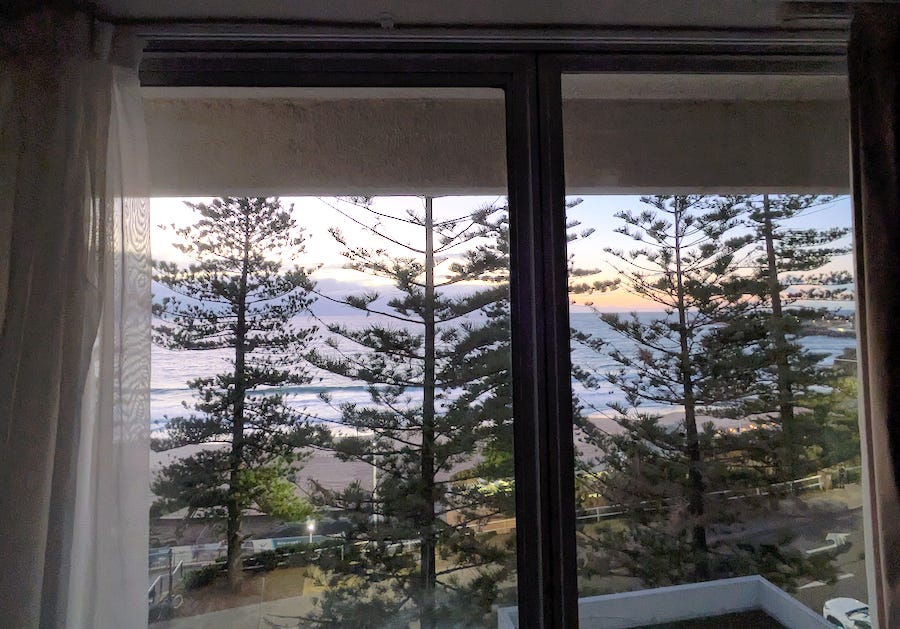
I always stay at the Novotel Northbeach. It is becoming slightly dated now, but it remains a lovely hotel. This time I had a room overlooking the beach.
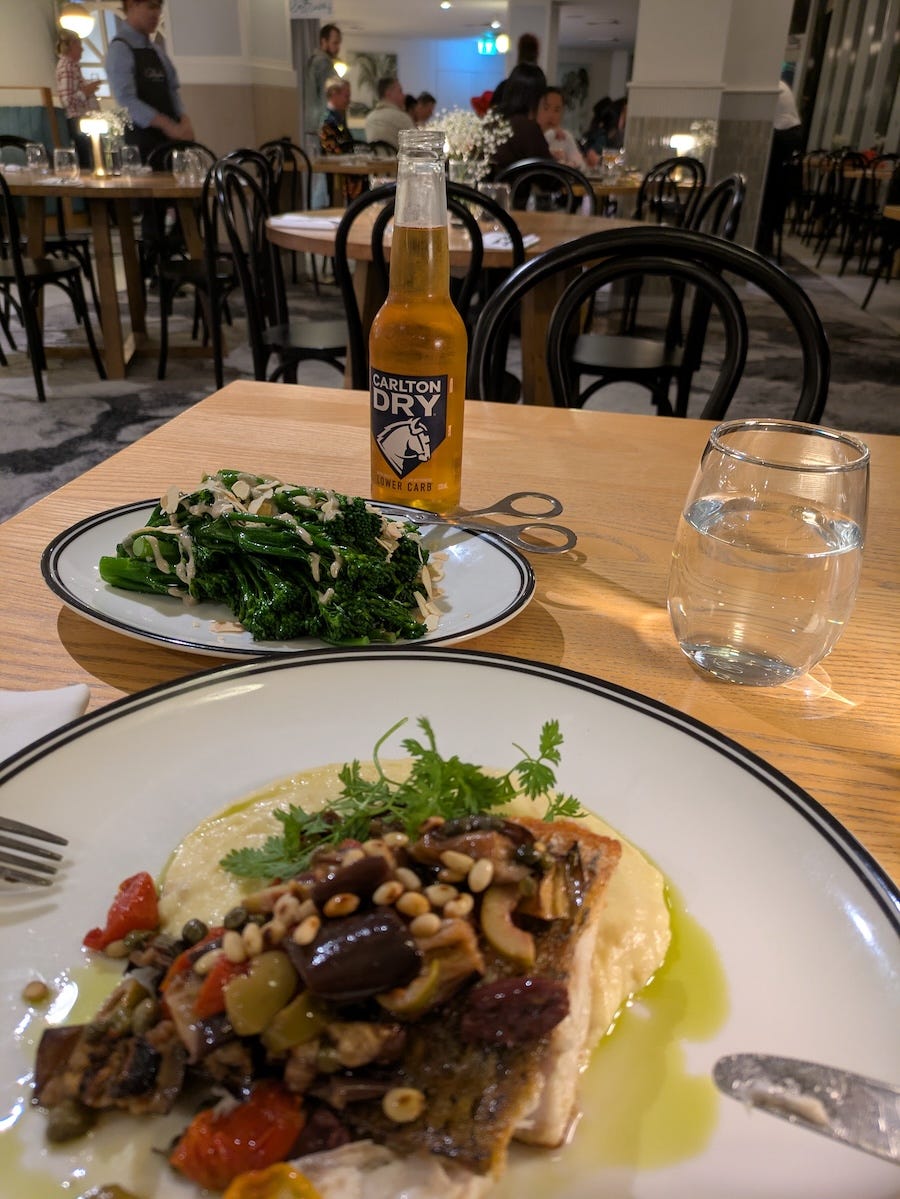
The hotel restaurant has never disappointed me. This visit I had grilled barramundi with broccolini and a Carlton Dry to wash it down.
There was nothing worth watching on television. I tried to read but succumbed to sleep around 9:30 pm.
I woke around six and went out for a walk before breakfast. It was remarkable how many people were already outside at that hour of the morning.
The temperature was fourteen degrees, yet some had decided to swim anyway.
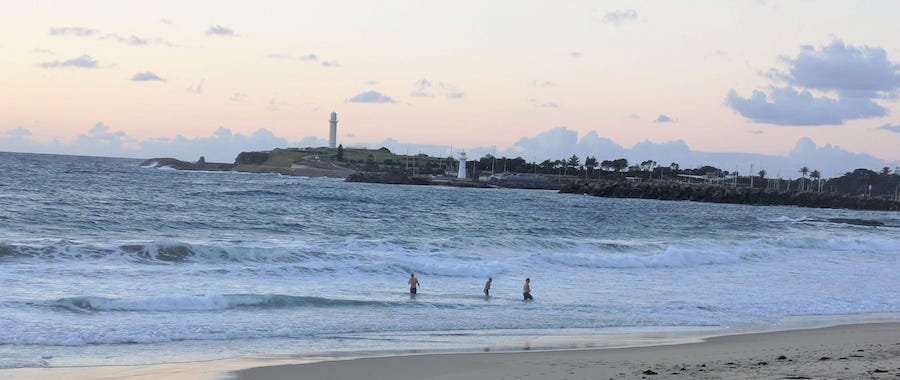
Others walked along the waterfront carrying takeaway coffees.
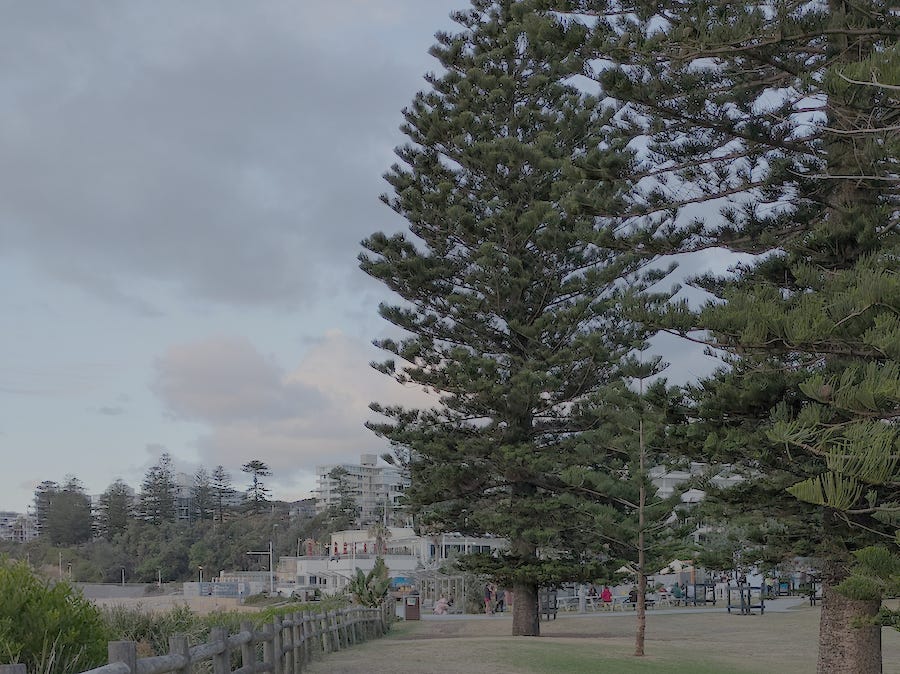
It appears to be a local ritual to gather in the park before work. At one point, a woman asked her phone, “What is Erin’s coffee?” The answer, repeated aloud, was “skinny cap.” It took me a few seconds to realise that “Erin’s coffee” was simply shorthand for a skim-milk cappuccino.
Nearby seagulls rested along the creek flowing into the sea.
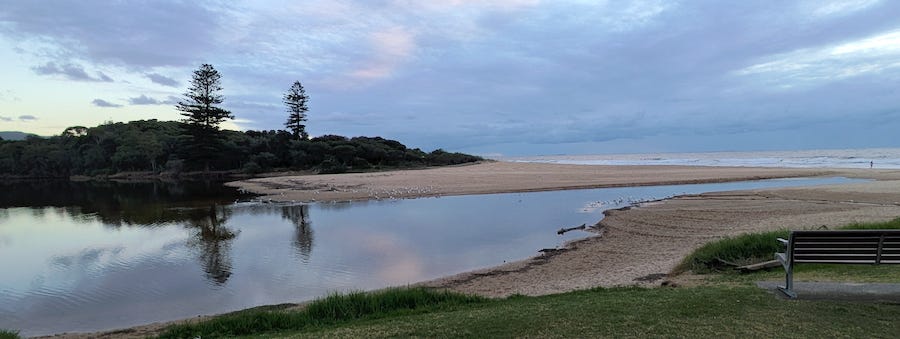
After breakfast and a shower, I checked out and drove to campus, arriving an hour early. I walked around the grounds before the meeting.
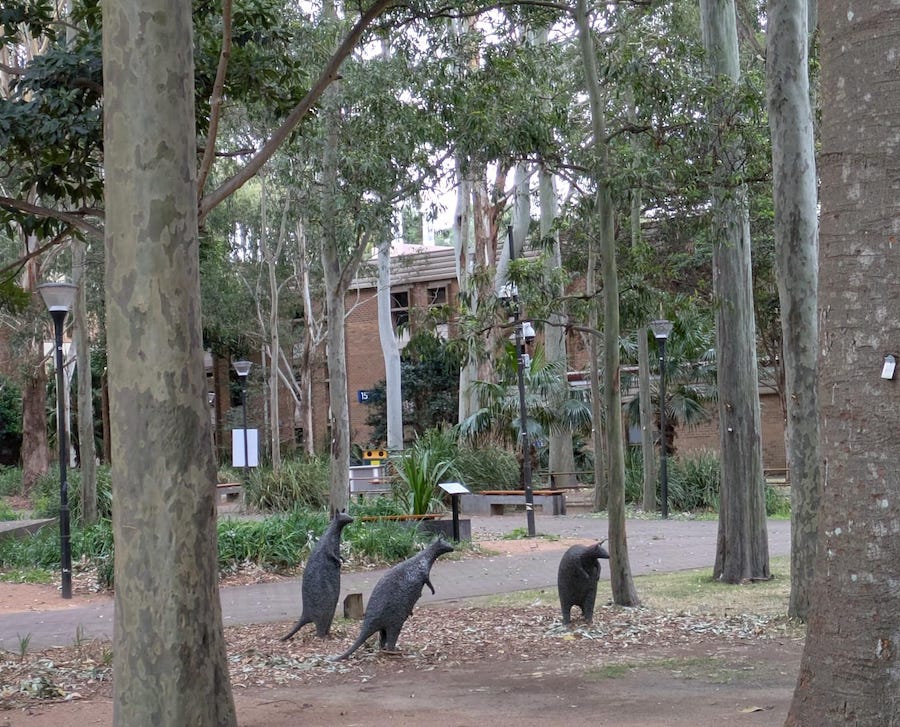
After passing the bronze kangaroos, I noticed a brightly decorated bicycle container:
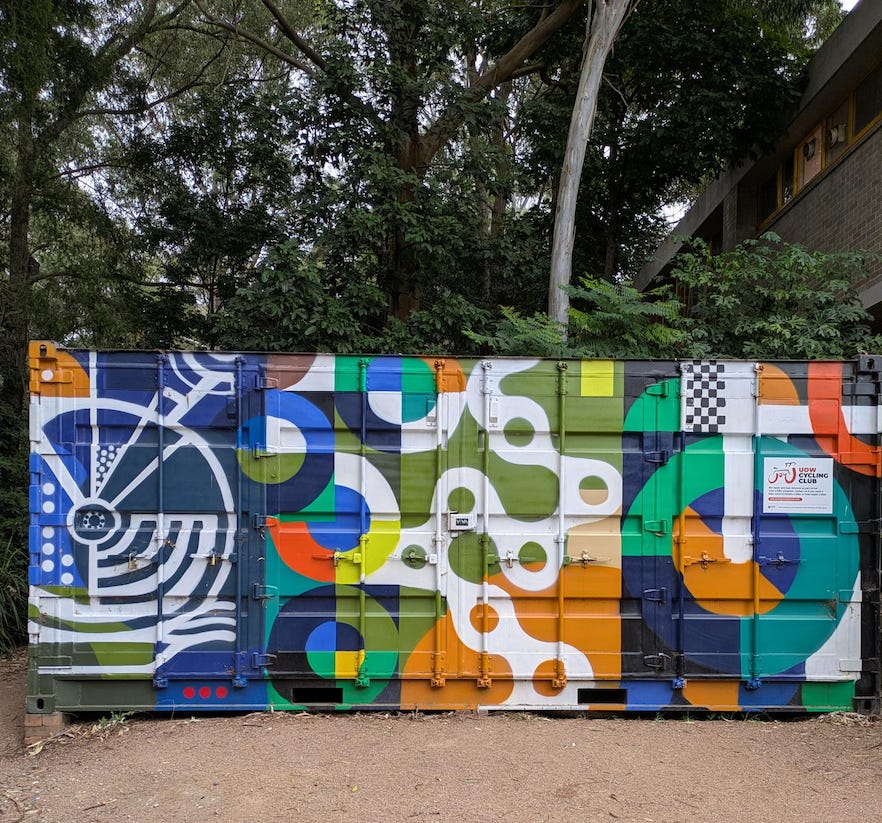
Then I bought a jumbo long black and went to the meeting.
-+-+-+-+
Books I Read
Ghost Cities — Siang Lu is a Chinese-Australian author based in Sydney. The novel follows the surreal adventures of Xiang Lu, a Sydneysider of Chinese background who, despite not knowing Chinese, briefly works as a Chinese-English translator using Google Translate. The book moves along two parallel storylines: one set in ancient China involving a cruel emperor, and the other in the present day among Chinese movie producers and eerily empty ghost cities. Strange, absurd, and often very funny. ⭐️⭐️⭐️
Lucky’s — This novel by Andrew Pippos is a multi-generational Australian story centred on a family-run restaurant business and migrants from the Greek islands. I have noticed this before: life on many Aegean islands has always been difficult, and some of these islands produced remarkably large migration waves. I personally know many Greek Australians from Kythera. Pippos mentions Ithaca in the novel. ChatGPT informs me that there was indeed migration from Ithaca to Australia, although not on the same scale as islands such as Castellorizo, Kythera, Crete, or Samos. ⭐️⭐️⭐️⭐️
Elder Race — I have a suspicion that Adrian Tchaikovsky wrote this novella partly as an homage to Ursula K. Le Guin, who died in 2018, three years before Elder Race was published. There are similar themes and moods. A tired and not entirely competent interstellar scientist is stranded on a planet where the natives treat him as a wizard. The story cleverly shifts between fantasy and science fiction depending on whose perspective we are following. ⭐️⭐️⭐️⭐️
-+-+-+-+
Comparing Istanbul and Brisbane prices - AT index
Based on my basket of goods, I compare Turkish and Australian prices. Both Coles (AU) and Migros (TR) prices are expressed in Turkish liras in the following tables. I converted Coles prices to Turkish liras at the exchange rate of 1AUD=32.91TRY.

I started this section on 5 July 2024. The Turkish prices initially rose fast. Since February 2025, the Turkish prices had been getting increasingly lower compared to the Australian prices. The trend seems to have been reversing with the Turkish prices rising again compared to the Australian prices but is highly volatile.
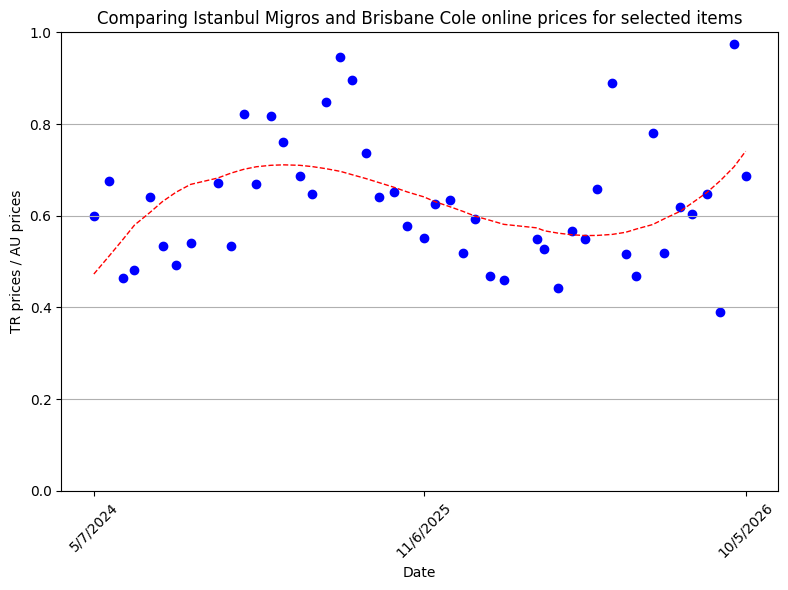
Some items, e.g. beef mince and rice, have consistently been more expensive in Istanbul. Raw data can be downloaded from my github page.
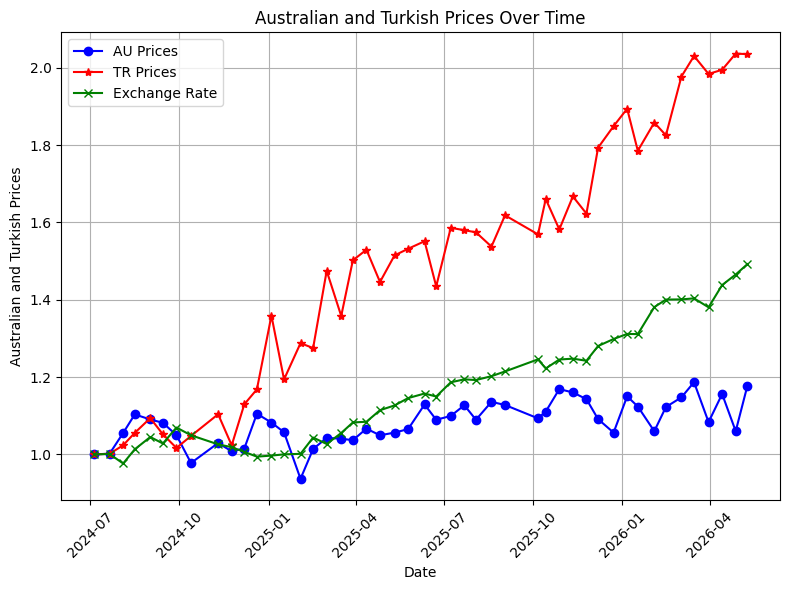
The following chart shows the variation of the total cost for the basket in each country separately taking 5 July 2024 as the base.
Wages
The Australian minimum wage was increased to almost $25/h on 3 June 2025. This corresponds to A$4000/month for a 160-hour month. The Australian workers being paid the minimum wage are about 2.6 million or about 18% of the total Australian work force.
The minimum wage in Turkey is 26,000 TRY/month.
The code to create the above tables and the charts is in my github repository and can be downloaded if you are interested
Statistics
The current count is 493 subscribers; 671 followers.
I thank you all for your support. Please continue your shares and mentions.